
Ingredients
Dough
- 500 g unbleached all-purpose flour about 4 cups plus 2 tablespoons; gram weight is preferred
- 340 g water room temperature, about 1 1/2 cups
- 3 g instant yeast about 1 teaspoon
- 10 g fine salt about 1 2/3 teaspoons; use weight because crystal sizes vary
For shaping and baking
- 15 g all-purpose flour up to 2 tablespoons, for dusting
- 250 g boiling water about 1 cup, for the steam pan only; not mixed into the dough; omit if your oven does not permit steam
Equipment
- 1 large mixing bowl and spoon with a cover
- 1 kitchen scale preferably with 1 g precision
- 1 dough scraper
- 1 18-by-13-inch rimmed baking sheet with parchment rated for 450°F
- 1 bread lame or very sharp knife
- 1 cast-iron skillet and heatproof pouring jug only if your oven manufacturer permits the steam method
- 1 pair of long oven mitts
- 1 Wire cooling rack
Instructions
- Mix 500 g flour, 340 g room-temperature water, 3 g instant yeast and 10 g fine salt in a large bowl until no dry flour remains. Cover and rest for 20 minutes.
- Knead the dough for about 5 minutes until smoother and elastic, using damp hands or a scraper if it sticks. Keep it slightly tacky rather than adding lots of flour. Return it to the bowl and cover.
- Let rise for about 2 hours at a comfortable room temperature, around 75°F (24°C), until noticeably expanded and aerated. At 30 and 60 minutes, lift one edge and fold it over the center; repeat around the bowl. Use the dough's expansion as the main cue and allow longer in a cool room.
- Lightly dust the counter with some of the 15 g extra flour. Divide the dough into 3 equal pieces. Gently form short logs, cover, and rest for 20 minutes to relax.
- Pat one piece into a short rectangle. Fold a long edge into the center and seal gently; repeat from the other side. Fold in half lengthwise and seal the seam. Roll gently from the center outward into a tapered 14-inch (35 cm) loaf. Repeat with the remaining dough. If a piece resists stretching, cover and rest it a few minutes before continuing.
- Place the loaves seam-side down, with space between them, on an 18-by-13-inch rimmed baking sheet lined with parchment rated for 450°F. Cover loosely and proof for about 45 minutes, or until puffy and a light fingertip dent springs back slowly. The loaves need not double.
- During the final rise, heat the oven to 450°F (230°C). If your oven manufacturer permits steam, place an empty cast-iron skillet on the lowest rack, below the bread position; never on the oven floor. Bring 250 g water to a boil. With a lame or very sharp knife, make 3 overlapping diagonal slashes about 1/4 inch deep on each loaf.
- Put the bread on the middle rack. Wearing long oven mitts and keeping your face and arms away from rising steam, carefully pour the boiling water into the cast-iron skillet and close the door. Do not pour water onto glass, the oven floor or heating elements. If steam is not permitted for your oven, omit the pan and water; the crust may differ.
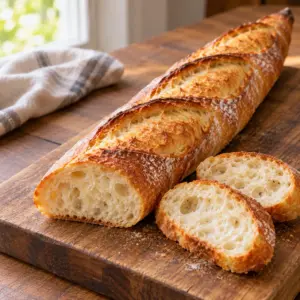
- Bake for 20 minutes. Open the door carefully to release steam; remove the skillet only if it is safe to handle. Continue baking for about 5 minutes, until the loaves are deeply golden with firm sides. If they are still pale, give them a few more minutes. Transfer to a rack and cool for at least 30 minutes before slicing.
Nutrition
Calories: 160kcalCarbohydrates: 33gProtein: 6gSodium: 330mg
Video
Notes
Yield: 3 baguettes, each about 14 inches (35 cm), or 12 quarter-loaf portions. The timeline is approximate and can lengthen in a cool kitchen. The 20-minute rests, 2-hour first rise, 45-minute proof and 30-minute cooling period are included in the listed resting time.
Video credit: King Arthur Baking Company, “Baking Baguettes You Can Brag About,” with Martin Philip. The video demonstrates an overnight poolish dough; this version uses a same-day direct dough. Follow the quantities, timeline and safe steam instructions above for this recipe.
Nutrition is an ingredient-based estimate per quarter loaf, assuming all 15 g dusting flour is used, with no toppings. Actual amounts vary with flour labels and portioning. Estimated cost uses the amounts consumed at U.S. online prices checked October 22, 2026, not full package costs; water, oven energy and toppings are excluded.
Contains wheat. Let cool before wrapping. Best crust is on baking day; freeze well-wrapped portions for longer storage. Do not use the steam pan in an oven whose manufacturer advises against adding steam or water.