

A yogurt mentions live cultures, a snack bar advertises prebiotic fiber, and a supplement bottle lists billions of CFUs. The words sound related because they are, but they do not describe interchangeable products. Understanding the difference makes a grocery label less mysterious.
Prebiotics are substances selectively used by microorganisms in a way that provides a health benefit. Probiotics are live microorganisms that provide a demonstrated benefit when consumed in adequate amounts. One is a substance microbes use; the other is the microbes themselves.
I find it more useful to separate the definition from the sales pitch. Neither word means that everybody needs a supplement, and neither guarantees that a particular product will solve a digestive problem.
Prebiotic vs Probiotic at a Glance
The International Scientific Association for Probiotics and Prebiotics emphasizes that a prebiotic must meet specific criteria. Many familiar examples are fibers, but not every fiber qualifies as a prebiotic. Likewise, a living microorganism needs evidence of a health benefit to qualify as a probiotic.
| Question | Prebiotic | Probiotic |
|---|---|---|
| What is it? | A substance selectively used by microorganisms | Live microorganisms with a demonstrated benefit |
| Is it a living organism? | No | Yes |
| What might a label name? | A particular ingredient, such as inulin | A genus, species and specific strain |
| What matters beyond the name? | Evidence, amount and individual tolerance | Strain-specific evidence, amount and viability |
| Common misconception | Every fiber is a prebiotic | Every fermented food is a probiotic |
That last distinction matters in the kitchen. Fermentation describes a process, while probiotic describes organisms meeting an evidence-based definition. Some fermented foods contain live microbes, some do not, and live microbes alone do not establish a specific health benefit.
Find Food You Enjoy, Then Read More Closely
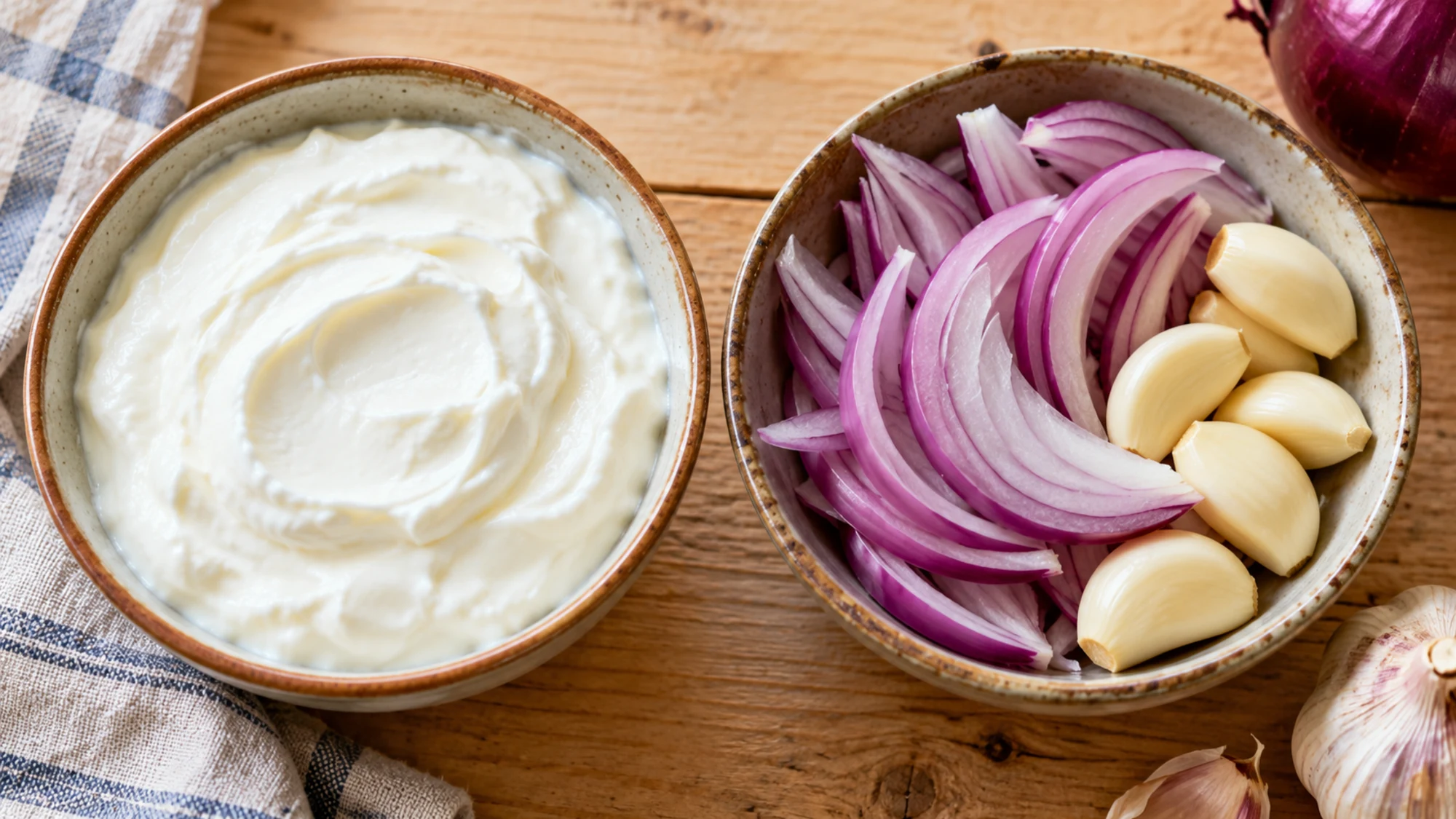
Onions, garlic, bananas and chicory can provide compounds discussed as prebiotics. That does not mean an ordinary serving supplies the same amount used in a particular study. Yogurt can contain live cultures, but checking the label is more useful than assuming every tub has the same organisms.
- Build variety with vegetables, fruit, beans and whole grains you actually enjoy.
- Check yogurt labels for the cultures or organisms identified by the manufacturer.
- Treat claims about fermented foods and probiotic benefits as separate questions.
- Compare specific ingredients instead of buying on the strength of a broad gut-health slogan.
I would start with familiar foods rather than rebuild the pantry around unfamiliar products. Ordinary meals can include a range of plant foods without turning every ingredient into a treatment. For a familiar breakfast idea, see Spoonvale’s apple cinnamon baked oatmeal.
Read Strains, Storage and Serving Sizes
For probiotics, a genus and species name may not tell the whole story. A specific strain can matter because research on one organism does not automatically support another. Look for evidence matching the purpose you have in mind, not simply a product with the most impressive-looking label.
CFU stands for colony-forming unit, a measure used to describe viable microorganisms. A bigger CFU number does not necessarily mean a better result. The NIH Office of Dietary Supplements advises looking at viable organisms through the end of the product’s shelf life rather than only at manufacture.
- What specific goal is this product intended to address?
- Does research support this strain or ingredient for that goal?
- What serving size and storage conditions does the label specify?
- Does the manufacturer state the amount expected through expiration?
A precise, modest claim is more useful than a promise to reset your gut. If the label leaves you guessing, bring it to a clinician or pharmacist before spending money on a supplement.

More Is Not Always More Comfortable
Adding a large amount of certain fibers at once can cause gas or bloating. A gradual change may be easier to tolerate, and an uncomfortable response is a reason to reassess the amount rather than assume you need to push through.
Probiotic supplements also deserve extra caution for people who are seriously ill or have weakened immune systems. NCCIH notes that risks can be greater in these groups, including infection. Ask a qualified health professional before using a product in those circumstances.
Persistent digestive symptoms deserve assessment rather than an endless rotation of supplements. Neither prebiotics nor probiotics should replace appropriate care or be presented as a universal answer to gastrointestinal symptoms.
Bottom Line
The prebiotic vs probiotic distinction is about a substance versus a living organism, with evidence required for both. Start with varied foods, introduce fiber changes gently, and ask specific questions about any supplement. A clear purpose and a readable label are better guides than the biggest number on the bottle.
The short ISAPP explainer below introduces the probiotic definition. It is an educational overview, not an endorsement of a particular product.
Sources
- ISAPP: Prebiotics
- ISAPP: Prebiotics infographic
- NIH Office of Dietary Supplements: Probiotics
- ISAPP: How to choose a probiotic
- NCCIH: Probiotics, usefulness and safety

Emily is Spoonvale’s recipe-writing persona, bringing a warm, practical voice to everyday cooking. Her focus is simple: approachable meals, comforting flavors, and clear instructions that help make time in the kitchen more enjoyable.