
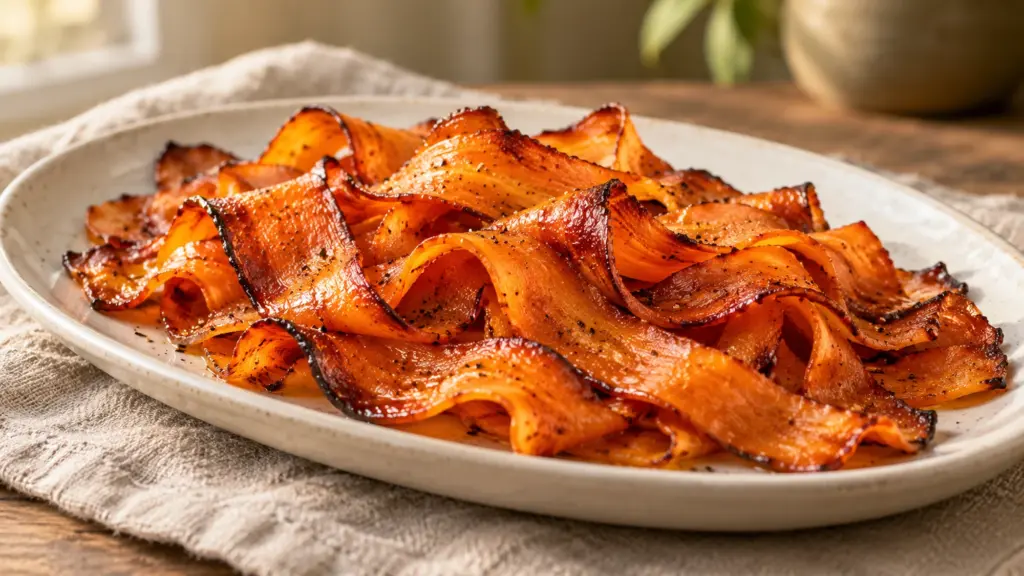
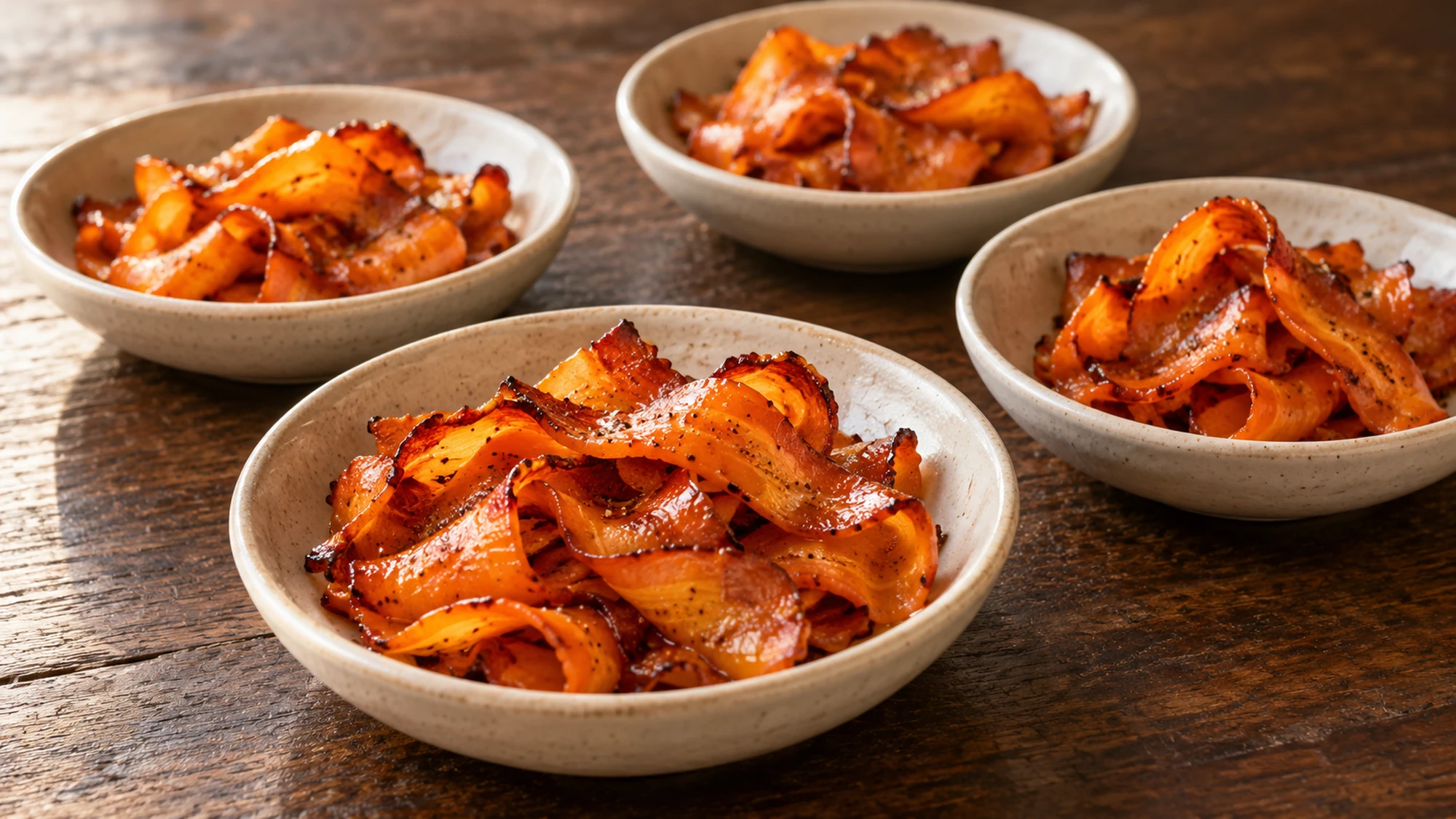
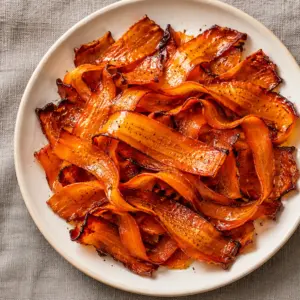
Carrot bacon turns a familiar vegetable into long, smoky ribbons with sweet edges and a savory finish. A vegetable peeler creates the thin shape, while maple, soy and smoked paprika give it depth. The most appealing pieces have a little curl, browned edges and an orange center that still bends.
The useful goal is a contrast of textures within each ribbon. Some edges become crisp as the carrots cool; thicker centers stay chewy. Watching those changes is more helpful than expecting every piece to finish at precisely the same minute.
Choose firm, fairly straight carrots with enough length to hold comfortably. Their shape matters more than their exact count: two large carrots can yield very different amounts of usable ribbons. Weigh the prepared ribbons so the glaze stays in proportion, and save the thicker cores for soup or another meal.
Serving Suggestions for Carrot Bacon
Treat these ribbons as a small side or a finishing layer. Their smoky sweetness works especially well beside foods with freshness, acidity or a plain, creamy texture.
- In a sandwich: Tuck a few ribbons into a split baguette with lettuce and tomato. Add them just before eating so the bread does not trap their steam.
- On a grain bowl: Pair with beans, cooked grains and crunchy vegetables for a more substantial meal.
- Beside breakfast: Serve a small portion with eggs or a tofu scramble; let those foods supply the meal’s main protein.
If I wanted the most noticeable edge texture, I would bring the ribbons to the table separately and let everyone add their own.
Serve soon after cooling, and keep wet dressings away until the final moment.
Carrot Bacon Variations and Ribbon Thickness
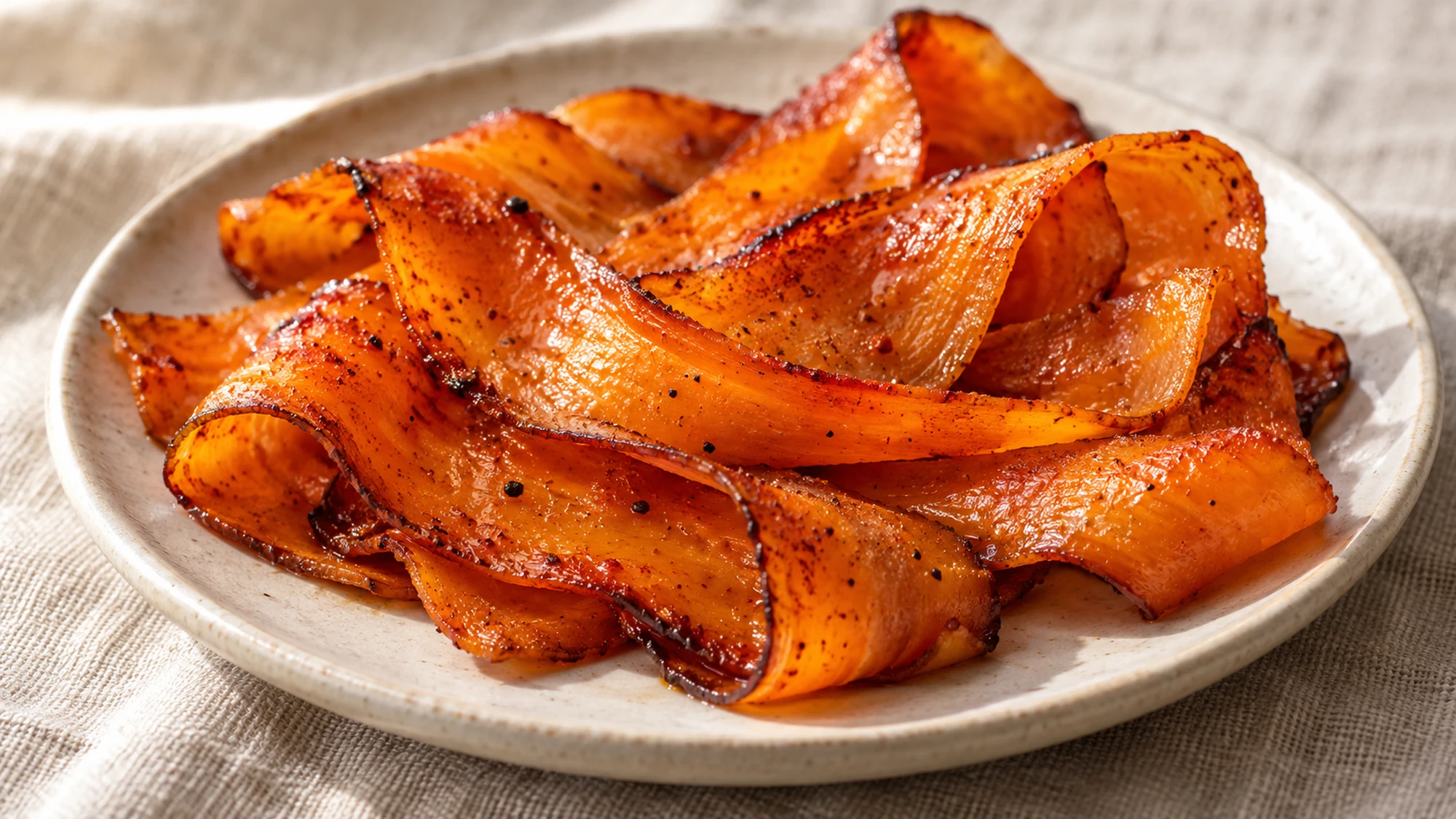
Small seasoning changes work better than making the ribbons thicker. A heavier cut changes the result into a soft roasted carrot strip and needs a different cooking schedule.
| What you notice | What it means | A useful response |
|---|---|---|
| Ribbons overlap | Moisture collects between layers | Give each piece space |
| Thin tips darken first | Thickness varies along the carrot | Lift those pieces off early |
| Centers bend after cooling | The ribbon retained moisture | Enjoy the chewy middle |
| Edges taste bitter | The glaze browned too far | Shorten the next batch’s finish |
- For gentle heat: Add a pinch of cayenne to the coating. Taste the finished batch before increasing it next time; the glaze concentrates in the oven.
- For a milder smoky flavor: Replace half the smoked paprika with sweet paprika. The carrot’s own sweetness becomes more noticeable.
- For a wheat-free option: Use a soy-based tamari specifically labeled gluten-free. Check its sodium information too, because products differ.
If my carrots were unusually narrow, I would accept shorter ribbons instead of pushing the peeler toward my fingers. Keep your grip secure, and stop when the remaining core becomes awkward.
Change the seasoning to suit the meal while keeping the ribbons thin and the pan uncrowded.
Health Benefits
Carrots bring useful nutrients to this small side, but the coating and portion still matter.
- Produce care: Start with clean produce even when peeling it. The FDA’s produce guidance recommends washing under running water before cutting or peeling, then drying with a clean towel. Soap and produce detergent are unnecessary. Dry surfaces also help keep the coating light.
- Carotenoids: Carrots provide beta-carotene, which the body can convert to vitamin A. The NIH explains vitamin A’s roles in normal vision and immune function.
- Meal balance: These are vegetable ribbons. Pair them with a protein food and a satisfying starch when building a full meal.
- Sodium and sweetness: Reduced-sodium soy sauce still contains sodium, and maple syrup contributes added sugar. Measure both rather than pouring freely.
Refrigerate leftovers promptly in a shallow covered container. USDA leftover guidance gives a three-to-four-day refrigerated window at 40°F or below. Chilling softens the edges, so plan to use leftovers as a tender topping.
Enjoy the flavor in a modest portion and let the rest of the plate bring variety.
Bottom Line
Carrot bacon works best when its thin shape and smoky glaze complement the vegetable’s natural sweetness. Give the ribbons room, watch the smallest edges and allow a short cooling pause. You will have a flexible, savory topping with browned edges, ready to add character to a simple meal.
Carrot Bacon Recipe

Ingredients
- 200 g prepared thin carrot ribbons about 7 oz ribbons from 2–3 large carrots; scrub, trim and peel before weighing ribbons, about 1 mm thick; reserve thick cores for another meal
- 1 tablespoon reduced-sodium soy sauce 15 mL; contains soy and usually wheat
- 1 tablespoon pure maple syrup 15 mL
- 1 tablespoon olive oil 15 mL
- 1 teaspoon smoked paprika
- 1/2 teaspoon garlic powder
- 1/8 teaspoon ground black pepper
Equipment
- Vegetable peeler; small knife and cutting board
- kitchen scale
- Mixing bowl, small whisk and tongs
- Measuring spoons
- Two large rimmed baking sheets and parchment paper
- Oven and cooling rack
- Food thermometer for reheating leftovers
Instructions
- Scrub the carrots under running water, dry them, then trim and peel. Use a vegetable peeler to shave long, very thin ribbons, about 1 mm thick, turning the carrot as needed. Stop before the remaining core becomes difficult to hold safely. Weigh 200 g of prepared ribbons; reserve the thick cores for another meal.
- Heat a conventional oven to 350°F (175°C), with racks in the upper and lower thirds. Line two large rimmed baking sheets with parchment paper. Use parchment rated for the oven temperature.
- Whisk together the soy sauce, maple syrup, olive oil, smoked paprika, garlic powder and pepper in the bowl and toss the carrot ribbons until very lightly coated. Let stand for 5 minutes.
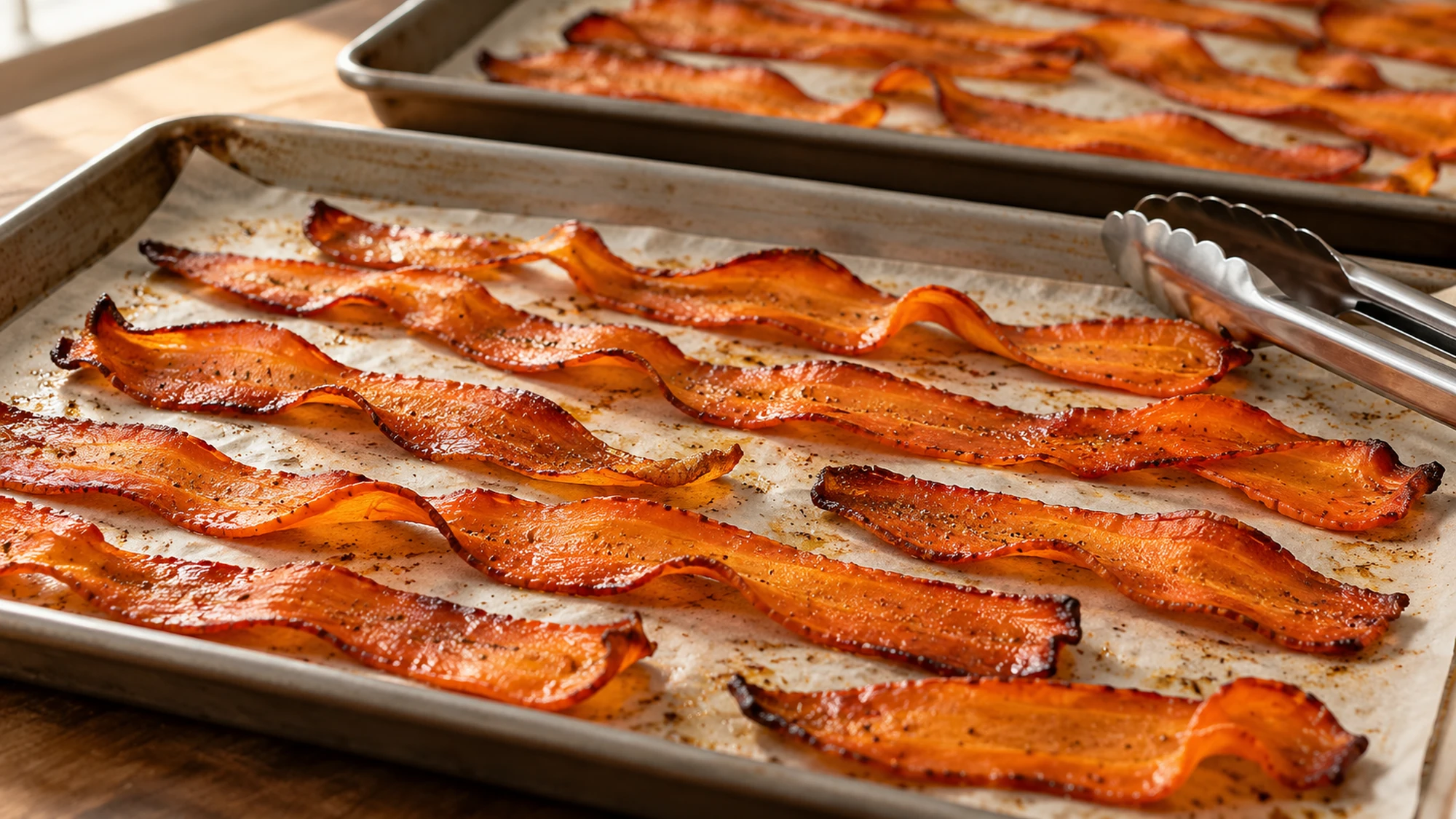
- Lift the carrot ribbons from the bowl with tongs and let excess coating drip back into the bowl. Arrange on the sheets in a single layer, without folds or overlap; discard any coating left in the bowl. If the ribbons do not fit without overlap, bake in separate batches.
- Bake for about 16–22 minutes, flipping the ribbons with tongs and rotating the sheets from top to bottom and front to back after 10 minutes. From 14 minutes, check frequently and remove individual ribbons as the edges brown and curl; the centers should still have a little flexibility. Stop before the glaze becomes black or bitter. Thickness, pan and oven variation can change finishing time.
- Leave the ribbons on the sheets for 2 minutes, then move them carefully to the cooling rack for 3 minutes more. Some edges will firm as they cool; thicker centers remain chewy. Divide into 4 small side portions and serve promptly.
- Refrigerate in a shallow covered container within 2 hours, or within 1 hour if the temperature is above 90°F. Keep at 40°F or below and use within 3–4 days. Reheat leftovers to 165°F, checking a small stack with a food thermometer. Expect softer texture after storage.
Video
Notes
Tried this recipe?
Let us know how it turned out!Emily is Spoonvale’s recipe-writing persona, bringing a warm, practical voice to everyday cooking. Her focus is simple: approachable meals, comforting flavors, and clear instructions that help make time in the kitchen more enjoyable.