
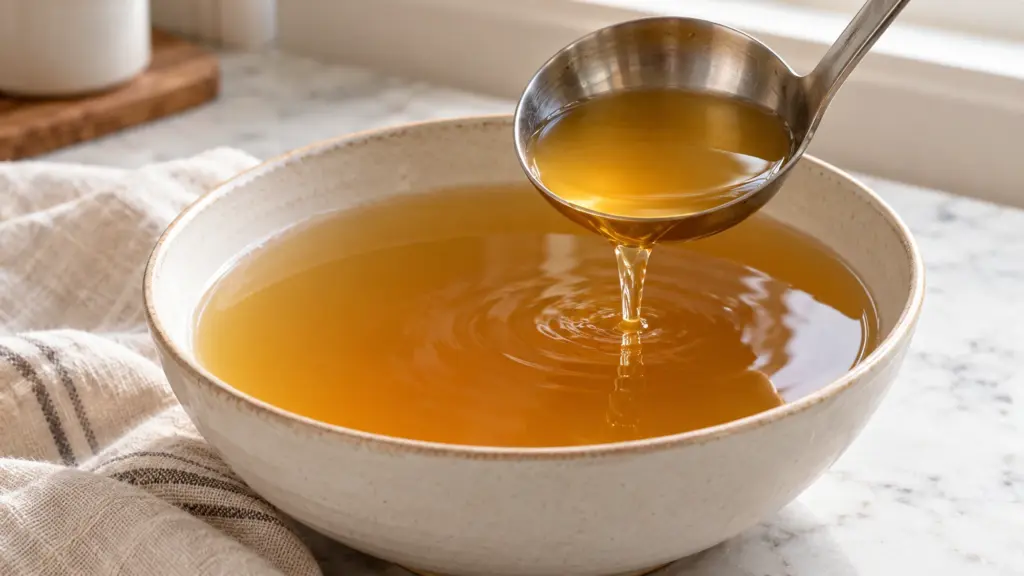
Soup can start with a carton, but there is another option when onions, carrots, and celery are on the counter. If you are wondering how to make vegetable stock, the useful answer is simple: simmer clean vegetables and herbs gently, then strain off the fragrant liquid. Mushrooms give this version a rounded, savory backbone without turning it into mushroom soup.

This unsalted vegetable stock makes about eight cups, with a gentle simmer rather than an afternoon of cooking. Keep it plain now, then season the soup, rice, or sauce you make with it later.
I prefer a stock that supports the next dish rather than announcing every herb in the cupboard. Here, parsley, thyme, and one bay leaf stay in the background. The strained stock has a golden-brown tint and will not set like bone stock.
Serving Ideas for Homemade Vegetable Stock
Think of this as a cooking ingredient, not a finished soup. Without added salt, it may taste quieter than boxed broth when sipped alone. Judge it in the dish you are making, especially if that dish also contains salty cheese, canned beans, or a concentrated sauce.
Use this small guide to choose a starting point:
| What you are making | How to use the stock | What to watch |
|---|---|---|
| Rice or other grains | Replace the recipe’s water with the same volume of stock | Keep the grain’s usual liquid ratio |
| Blended vegetable soup | Use stock for the cooking liquid | Season after blending |
| Risotto | Keep the stock warm and add it gradually | The rice determines the final amount |
| Pan sauce | Add a small splash to loosen browned bits | Taste again after reducing |
For a mug of broth, season only the portion you are drinking. A little lemon juice can brighten it, but keep that addition out of the main batch if you want a versatile freezer staple.
Start with the liquid amount your next recipe specifies; homemade stock does not require a new set of cooking ratios.
How to Make Vegetable Stock Your Own
Cremini mushrooms bring an earthy note; white button mushrooms make a straightforward alternative. Clean leek greens can replace some of the onion, although grit between their layers needs careful rinsing.
- For a gentler mushroom flavor, replace half the mushrooms with the same weight of onion. The stock will be sweeter and less earthy.
- For more parsley aroma, include the tender stems as well as the leaves. Keep the total amount the same instead of packing in another handful.
- For a more neutral base, leave out the thyme. Do not replace it with a larger amount of another dried herb automatically.
- For a scrap-based batch, use only clean, sound, edible trimmings. Freeze them while fresh rather than treating stock as a rescue for spoiled produce.
The guidance on using washed vegetables and trimmings is a helpful starting point. This recipe deliberately uses a measured mix so the result is less of a guessing game. Strongly flavored additions can dominate a stock, so make one change at a time.
I would choose a balanced pot over a crowded one: a useful stock should leave room for whatever comes next.
Health Benefits, Cooling, and Storage
It is not a substitute for eating vegetables, and straining removes the solids that contain much of their fiber. Adding up the nutrition of every raw ingredient would therefore overstate what ends up in your cup. Nutrient extraction and final concentration also vary, so an exact nutrition panel would be misleading here.
Keep the storage plan as deliberate as the cooking:
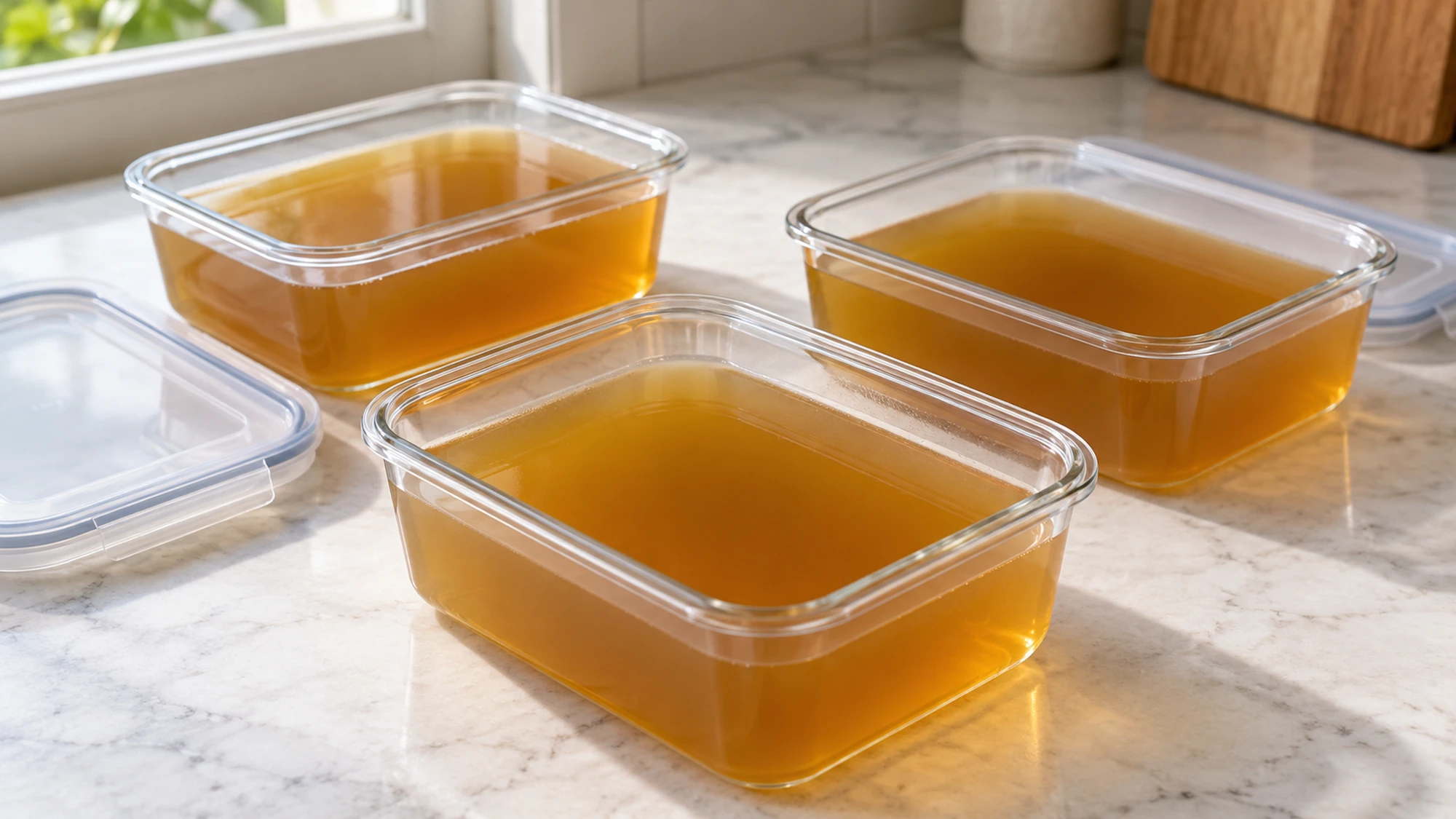
- Divide the strained stock into small, shallow containers and refrigerate promptly, within two hours of cooking, or within one hour above 90°F/32°C. Do not leave a large pot on the counter to cool overnight.
- Keep refrigerated stock at 40°F/4°C or below and use within three to four days. Freeze portions you will not use in that window.
- For best freezer quality, use within two to three months. Leave expansion space in freezer-safe containers and label the date and amount.
Follow the guidance on cooling leftovers quickly. This is a refrigerator-or-freezer recipe, not a shelf-stable preserve; vegetable stock needs a tested process for canning.
Small labeled portions make the next meal easier without leaving food safety to guesswork.
Bottom Line
Good vegetable stock does not need a long ingredient parade. A measured mix of vegetables, a few restrained seasonings, and a gentle simmer give you a flexible base for everyday cooking. Keep the batch unsalted, strain it well, and cool it promptly. Then choose one meal to use it in and freeze the rest in amounts you will actually reach for.
How to Make Vegetable Stock Recipe


Ingredients
- 8 oz cremini mushrooms 227 g, cleaned and quartered
- 2 medium yellow onions 300 g prepared, peeled and roughly chopped
- 2 large carrots 200 g, scrubbed, trimmed, and roughly chopped
- 3 stalks celery 150 g, washed and roughly chopped
- 3 cloves garlic 9 g, peeled and lightly crushed
- 15 g fresh parsley washed stems and leaves, about 1 small handful
- 1/2 tsp dried thyme about 0.5 g
- 1 dried bay leaf about 0.2 g
- 1/2 tsp whole black peppercorns about 1 g
- 10 US cups water 2.37 liters
Equipment
- 6-quart stockpot
- Cutting board
- Chef’s knife
- Measuring cups and spoons
- Kitchen scale for gram measurements
- Long-handled spoon
- Fine-mesh strainer
- Large heatproof bowl or second pot
- Ladle
- Small shallow refrigerator/freezer-safe containers
Instructions
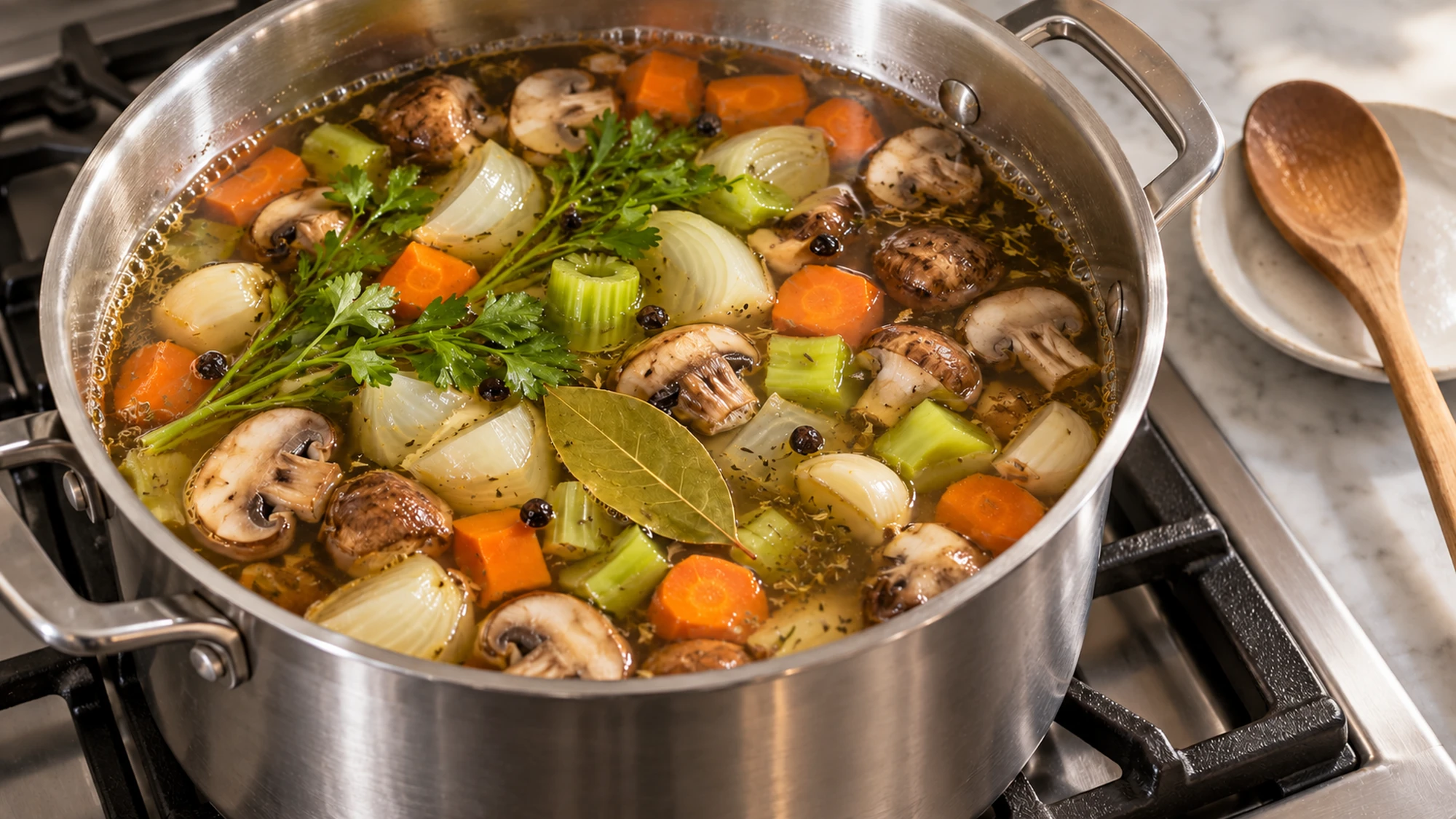
- Wash the mushrooms, carrots, celery, and parsley. Peel the onions and garlic. Quarter the mushrooms, roughly chop the onions, carrots, and celery into similar-size pieces, and lightly crush the garlic.
- Put all the vegetables, parsley, thyme, bay leaf, and peppercorns in a 6-quart pot. Add 10 US cups (2.37 liters) water. The vegetables should be just submerged; press them down gently rather than packing the pot.
- Heat over medium-high until the liquid just begins to boil, about 10–15 minutes. Reduce the heat to maintain a gentle simmer, with small bubbles rather than a rolling boil.
- Simmer uncovered for 45 minutes, stirring once or twice. Taste a cooled spoonful: the stock should have a mild, savory vegetable flavor. Keep it unsalted so you can season the finished dish later.
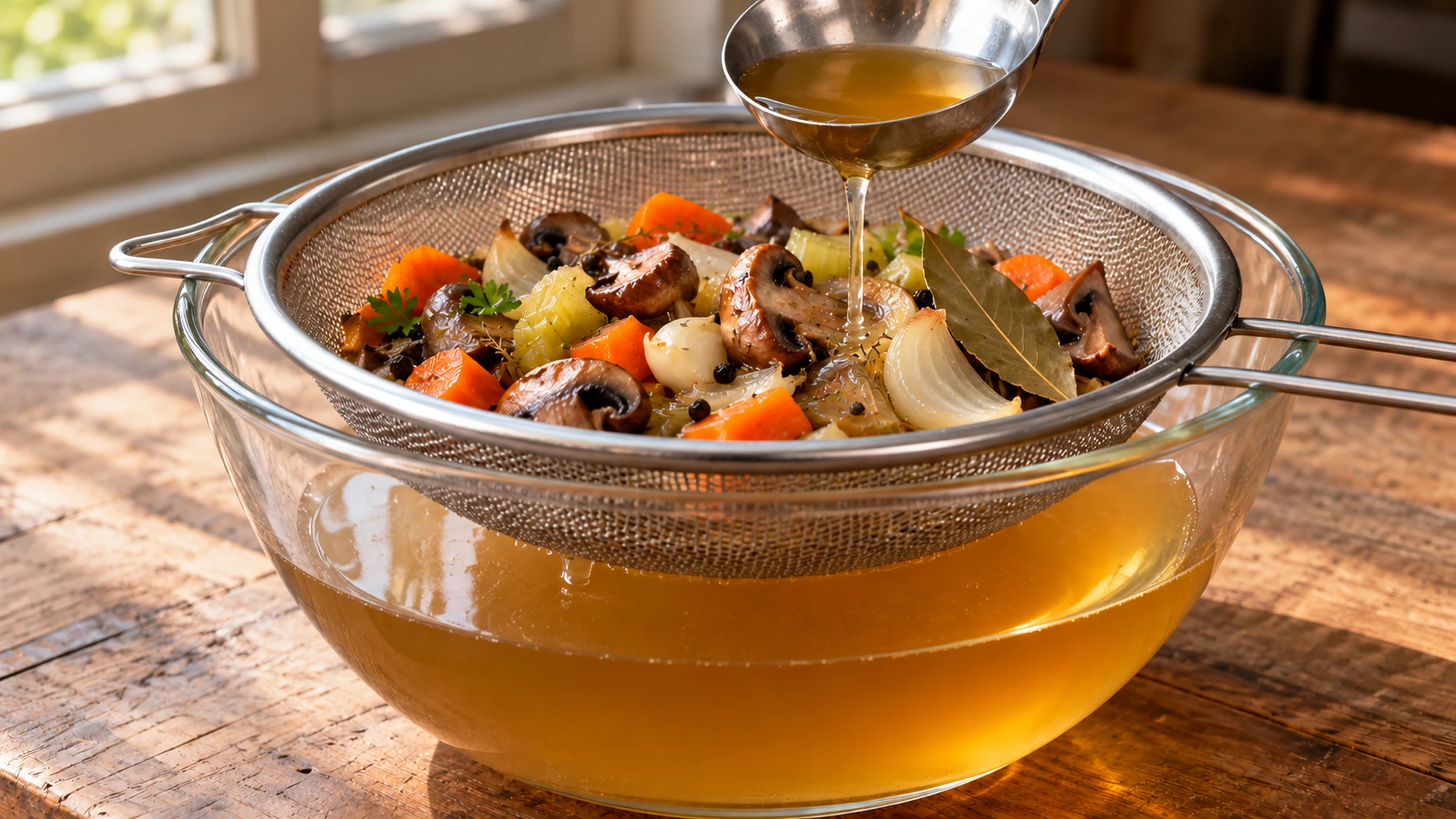
- Set a fine-mesh strainer over a large heatproof bowl or second pot. Ladle or carefully pour the stock through it without pressing the vegetables. Remove the spent vegetables, bay leaf, and peppercorns. Expect about 8 cups; evaporation and liquid retained in the vegetables affect the final amount.
- Use immediately, or divide into small, shallow containers and refrigerate promptly within 2 hours of cooking, or within 1 hour above 90°F/32°C. Keep at 40°F/4°C or below for 3–4 days. Freeze for 2–3 months for best quality, leaving expansion space.
Video
Notes
Tried this recipe?
Let us know how it turned out!Emily is Spoonvale’s recipe-writing persona, bringing a warm, practical voice to everyday cooking. Her focus is simple: approachable meals, comforting flavors, and clear instructions that help make time in the kitchen more enjoyable.